
Coastal barriers, raised structures among recommended measures to protect Greater Southern Waterfront and Changi from rising sea levels
30 Aug 2025



Singapore, 30 August 2025 – National water agency PUB has completed the first coastal protection site-specific study1 (SSS) for the City-East Coast, which includes Greater Southern Waterfront (GSW) and Changi. Deputy Prime Minister and Minister for Trade and Industry Gan Kim Yong was the Guest-of-Honour at the inaugural Coastal Protection Exhibition on 30 August 2025 at VivoCity.
2 The SSS, which commenced in 2021, has recommended building coastal barriers to protect a substantial portion of the GSW coastline, as well as a mixture of solutions such as raised structures and tidal gates for Changi. The recommendations for Changi and GSW, together with ‘Long Island’2 , will form a continuous line of defence to protect City-East Coast against rising seas (refer to Annex for infographic on the proposed measures).
Greater Southern Waterfront (GSW)
3 The GSW region will be a new major gateway and location for urban living along Singapore’s southern coast. Notable developments include residential and commercial areas such as HarbourFront and Keppel Bay, as well as nature spaces like Berlayer Creek. Together with Sentosa Island and Pulau Brani, this area will be transformed into a mixed-use waterfront precinct with world-class leisure and tourism developments. The coastline comprises three segments:
• From Pasir Panjang Ferry Terminal to Labrador Nature Park;
• From east of Labrador Nature Park to Tanjong Pagar Terminal; and
• From Marina South to Marina East
4 Three coastal barriers and shoreline measures have been recommended for the GSW coastline for coastal protection. These measures will ensure that we optimise land use, preserve our waterfront experience, maintain public access to the coastline and improve connectivity.
.png?h=400&w=481&hash=6E3467A0B25A8B2CB0542DCCCFDD1B1F)
Proposed measures for Greater Southern Waterfront
Coastal barriers
5 There will be two coastal barriers linking eastern Sentosa to Pulau Brani and to mainland Singapore, providing opportunities for integration with future linkages proposed under the Greater Sentosa Master Plan. The third coastal barrier will connect western Sentosa to mainland Singapore. The exact location will be determined by further studies that balance technical feasibility, cost, and impact on biodiversity.
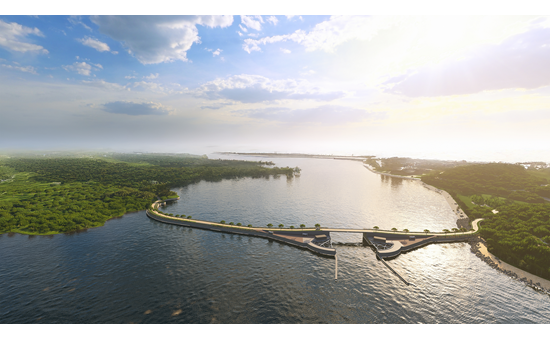
Artist’s impression: Coastal barrier concept which combines flood protection with enhanced transport connectivity between Sentosa and Pulau Brani.
6 The coastal barriers will comprise a series of gates across the water channels. The barriers will remain open by default to allow unimpeded maritime activities along the waterways, and close under high tide and storm surge conditions to protect the area against coastal flooding. Keeping the barriers open by default will also allow seawater to flow freely through the open barriers and minimise environmental impact. PUB had considered an alternative approach, which would involve raising seawalls and constructing tidal gates along the entire waterfront promenade for coastal protection. However, this would block sea views and take up more waterfront land.
7 For the coastline stretching from Pasir Panjang Ferry Terminal to Labrador Nature Park, and from Marina South to Marina East, existing measures will be upgraded. For example, we will raise existing revetments at Marina South. Marina Barrage will also be retrofitted to withstand future sea level rise. These measures will form a continuous line of defence along Singapore’s southern shores.
Changi
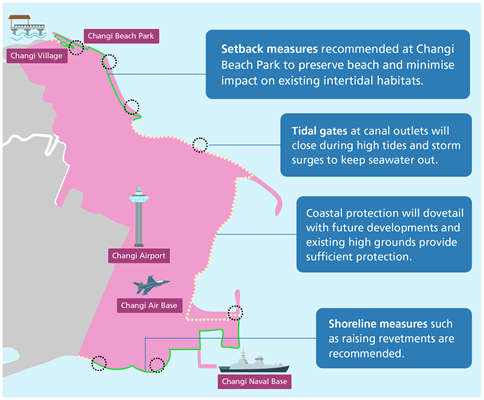
Proposed measures for Changi
8 Changi’s coastline features recreational spaces such as Changi Beach Park, as well as industrial and aviation facilities such as Changi Aviation Park and Changi Airport. The recommended coastal protection measures for Changi’s coastline include a mix of bunds, revetments, and tidal gates.
Setback measures
9 A possible measure would have been to raise the bunds in Changi Beach Park, which can also double up as a footpath or cycling track. In response to feedback gathered through our stakeholder and community engagements, coastal protection measures at Changi Beach Park will be positioned further inland to preserve access to our existing recreational spaces. This will maintain beach access and minimise impact to existing intertidal habitats, enabling biodiversity to thrive and nature lovers to continue to enjoy the area. While such areas forward of our coastal protection measures may see occasional, temporary flooding during extreme high tides, this design ensures continued waterfront access under normal conditions.
Tidal gates
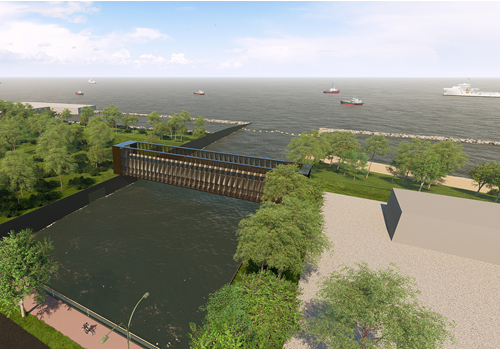
Artist’s impression: Tidal gate concept, integrated with waterfront and park spaces
10 At key locations where existing major canals discharge to the sea, tidal gates will be installed to prevent seawater intrusion during high tide events. The location and design of these tidal gates will be further studied to ensure that they integrate seamlessly with the landscape.
Shoreline measures
11 Changi South will see revetments or seawalls built on the coastline. Where such structures are already in place, these can be raised to enhance protection against future sea level rise. In designing and implementing such enhancements, there is potential to incorporate design considerations to ensure that they are not only functional but also add aesthetic and recreational value to the area.
12 Over the course of the SSS, PUB sought to develop multi-functional spaces that take into consideration land use plans while also protecting Singapore from coastal flooding. We have also taken in stakeholder feedback through the "Our Coastal Conversation" series of public dialogue sessions. We consulted diverse participants including residents, community leaders, nature groups, businesses, professionals and recreational users on the solutions they would like to see.
13 PUB and the relevant government agencies will next embark on studies to develop the preliminary and detailed engineering designs of the recommended measures, which will include environmental impact assessments. Construction of the measures is targeted to commence from the 2030s.
- END -
Footnotes:
[1] Site-specific studies at other sections of Singapore’s coastline are ongoing or will commence in the near future. More information here.
[2] The ‘Long Island’ project, announced in 2023, is an integrated solution that will protect the entire East Coast area. The East Coast is part of the site-specific study for the City-East Coast.
Annex: PUB Infographic - Safeguarding City-East Coast