Official website links end with .gov.sg
A Singapore Government Agency Website


Secure websites use HTTPS


Trade effluent refers to any liquid, including particles of matter and other substances suspended in the liquid, which is the outflow from any trade, business or manufacture or of any works of engineering or building construction.
| Scenario | Action to Take |
|---|---|
| Cessation of factory operation | Inform PUB in writing to cancel the WA. The WA will be cancelled and any deposit paid (applicable to those paying monthly trade effluent fees) will be refunded after settling all outstanding bills. |
| Relocation of factory | Inform PUB in writing of your new premises and apply for a new WA. Provide an updated business registration certification from the Accounting & Corporate Regulatory Authority (ACRA). |
| Change in factory status e.g. from sole proprietor to private limited | Inform PUB in writing of your new status and apply for a new WA. Provide an updated business registration certification from ACRA. |
| Change in factory name | Inform PUB in writing of the change in name and attach a copy of the updated business registration certificate from ACRA. Trade premises need not apply for a new WA. |
| Change in factory’s trade activity which will increase the volume of trade effluent to be discharged | Inform PUB in writing of the new activity and the volume of trade effluent to be discharged. Provide a copy of the updated process flow diagram(s) and other relevant documents e.g. chemical usage. PUB will assess if there is a need to apply for a new WA. |
If your company generates trade effluent intended for discharge into the public sewerage system, you will have to apply for a Written Approval (WA) from PUB. The WA specifies the conditions you have to comply with, if you wish to discharge trade effluent into the public sewerage system.
You can apply online for a WA through the GoBusiness Licensing Portal. For more details on the WA application procedures and requirements, please refer here.
You are responsible for ensuring your trade effluent is collected and disposed of responsibly. Discharging trade effluent into the public sewerage system without PUB’s approval constitutes a violation of the Sewerage, Drainage and Coastal Protection Act (SDCPA) and is illegal. As a business operator, you have a duty to ensure that any waste you generate is handled safely and in accordance with all environmental legislations.
All trade effluent discharged into the public sewerage system shall meet the water quality criteria specified in the SD(TE)R under the following categories:
a) Nature and type of trade effluent to be discharged,
b) Trade effluent to be free of certain substances, and
c) Maximum concentrations of certain substances.
For more details on the water quality requirements for trade effluent discharge into the public sewerage system, please refer to the latest Sewerage and Drainage (Trade Effluent) Regulations available on the Singapore Statutes Online website.
The trade effluent samples collected for analysis should be representative of the treatment quality from the pre-treatment plant.
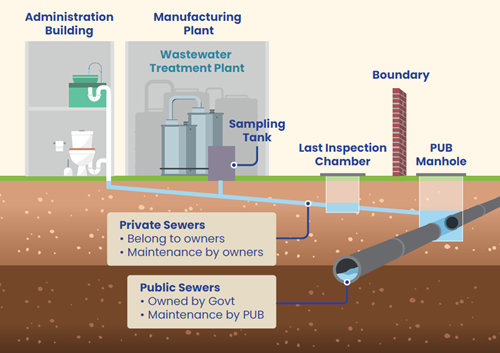
Samples must be collected from the sampling tank or sump of the pre-treatment plant (see figure above). The pollutants or parameters to be tested depend on the type of trade activity. In general, trade premises should test for:
These tests help assess the chemical and biological load of the trade effluent.
Trade premises should also test for specific water quality parameters relevant to their industry. For example, an electroplating facility that carries out copper plating should test for heavy metals such as copper.
For the full list of parameters and discharge limits, please refer to the Requirements for Discharge of Trade Effluent into the Public Sewerage System.
You can send your samples to an accredited laboratory for analysis. For a list of accredited laboratories, please visit the Singapore Accreditation Council website.
If you are unable to meet the water quality limits stipulated in the SD(TE)R, you can either:
The handling of toxic industrial wastes is regulated by the Environmental Public Health (Toxic Industrial Waste) Regulations [EPH(TIW)R], governed by NEA. Under the EPH(TIW)R, you need to engage a licensed toxic industrial waste collector to collect and dispose of your toxic waste off-site. You should not engage a general waste collector to collect your toxic industrial waste. You will need to properly account for all your waste generation. You may also be required to declare your waste disposal through NEA’s e-consignment system.
For more information on the proper handling of toxic industrial wastes, please refer to NEA’s website.
Trade premises that are unable to install a wastewater treatment plant (WWTP) (e.g. due to space constraints), or engage a licensed waste collector, to meet discharge limits for BOD or TSS may apply for the TEF scheme if their trade effluent contains BOD or TSS concentrations above 400 mg/L.
However, approval will not be granted if the trade effluent contains:
If you know of or suspect an accidental discharge or non-compliant trade effluent being discharged into the public sewerage system, please inform us immediately. This allows us to alert the water reclamation plants of any incoming non-compliant trade effluent, enabling them to take necessary action. You can contact us through PUB-ONE, our 24-hour hotline, at 1800-CALL-PUB (1800-2255-782).
Here are some practical tips to help prevent the accidental discharge of illegal trade effluent:
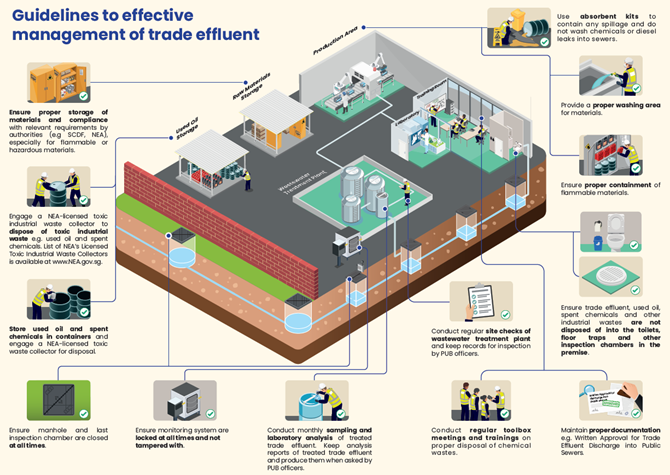
Housekeeping and Proper Storage of Chemicals
Process Monitoring
Maintenance Work
Emergency Preparedness and Response
Educating Employees and Contractors
Maintenance Schedule
If your facility has a pre-treatment plant, a maintenance schedule is essential to ensure its proper operation and adequate treatment of trade effluent. Refer to the plant’s operation manuals or consult your vendor, contractor or consultant to develop a comprehensive inspection and maintenance schedule.
Here are some useful pointers:
Process Monitoring Schedule
A process monitoring schedule, together with a maintenance schedule, helps ensure that your treatment process is operating effectively.
Here are some useful pointers:
Commercially available analytical kits and sensors may be used to measure water quality parameters.
An oil interceptor is a device that separates oil and grease from trade effluent. Oil interceptors are important as they reduce the amount of oil and grease entering the public sewerage system, thereby minimising the risk of sewer blockages. The figure below illustrates a typical oil interceptor.
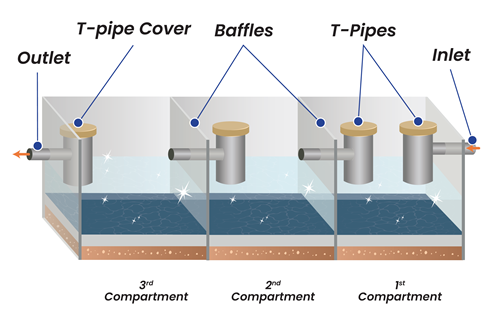
Here are some useful pointers:
i) Implement a Maintenance Schedule
Oil interceptors require regular maintenance to ensure effective treatment of trade effluent. Your maintenance schedule should include regular checks for:
ii) Implement a Monitoring Schedule
You should implement a monitoring schedule to regularly check the quality of trade effluent discharged from the oil interceptor. Consider the following:
Use the laboratory test results to review and adjust your oil interceptor maintenance schedule where necessary.
iii) Clean the Oil Interceptor Regularly
Oil interceptors should be cleaned regularly. The recommended cleaning steps are illustrated in the figure below.
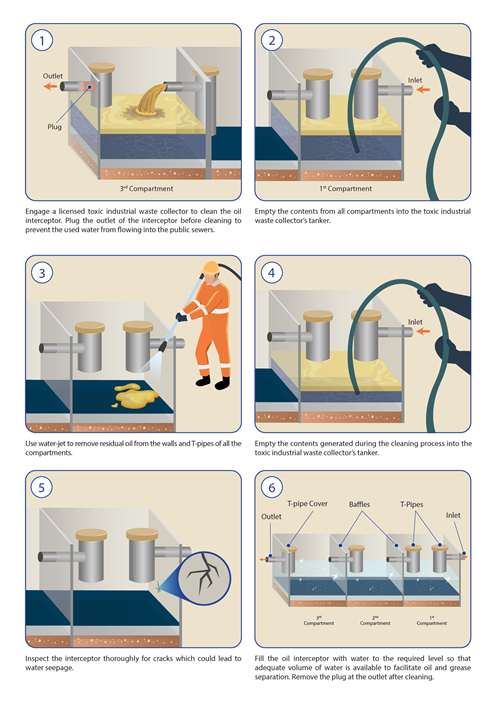
iv) Collection, Transportation and Disposal of Toxic Waste
The collection, transportation and disposal of toxic waste, including waste oil and spent solvents, are regulated under the Environmental Public Health (Toxic Industrial Waste) Regulations administered by the National Environment Agency (NEA). You should consult NEA for guidance on the proper collection, transportation and disposal of waste oil and spent solvents.
The discharge of effluent into the watercourse (e.g. open drains, canals and rivers) is regulated under the Environmental Protection and Management Act (EPMA) and the Environmental Protection and Management (Trade Effluent) Regulations. These are administered by the NEA.
For more information you may visit NEA’s website.
PUB aims to process all permit applications within 30 working days upon receiving all required documentation. This includes permits such as:
1. Written Approval for discharge of trade effluent into public sewerage system.
•
For Written Approvals, the required documentation is set out in the table below.
2. Permission to discharge TE exceeding BOD, COD or TSS limits (also known as Trade Effluent Fee (TEF) Scheme).
3. Permission to NEA-licensed General Waste Collectors (GWCs) to dispose effluent or organic sludge at Water Reclamation Plants.
Please ensure all supporting documentation is prepared and completed accurately to avoid processing delays.
|
No. |
Required Documentation |
Details |
Example |
|---|---|---|---|
|
1 |
Company's Business Profile i.e. Accounting and Corporate Regulatory Authority (“ACRA”) document |
Complete business profile that includes the company name, Unique Entity Number (UEN), registered office address, and primary and secondary activities.
Submissions that are missing any of these details will not be accepted. |
Latest full ACRA document clearly indicating:
|
|
2 |
Particulars of the trade, manufacture, business, or building construction |
In-depth information on company activities/ operations and how trade effluent is generated. This will assist PUB to understand the nature of trade effluent discharged.
The SSIC code is recommended to be provided, which should be related to the primary/secondary activity of the company. |
Example: "Metal plating operations using electroplating baths generate rinse water containing heavy metals and acids as waste being discharged into the sewerage system" |
|
3 |
Details of all processes/operations employed or to be employed, including process flow diagram |
Schematic diagram or flowchart showcasing how water flows through processes and how trade effluent is generated. |
Process flow diagram showing Example: Raw material → Cleaning → Plating → Rinsing → Wastewater generation |
|
4 |
Particulars of all raw materials and chemicals used or to be used in the processes or operations, including Safety Data Sheets (SDS) |
Detailed list of all chemicals used in processes/operations with an estimated quantity used monthly, together with the associated SDS documents.
Can be provided as PDF or an excel file if numerous chemicals are involved. |
Example: PDF/Excel file of the list of chemicals showing e.g. "Hydrochloric acid (10L/mth), Sodium hydroxide (5m3/mth), Copper sulphate (200kg/mth)" with attached SDS for every chemical |
|
5 |
Details of layout of all machinery, plant and equipment used or in the premises in which the trade, manufacture, business or building construction is being or is to be carried on, including wastewater treatment plant (WWTP) facilities |
Overview diagram showing placement of machinery and equipment in the premises, with clear labels of each machinery. WWTP facilities can be shown in a separate diagram from factory operations area. |
Site layout plan showing:
|
|
6 |
An estimate of the amount of water consumed or used or to be consumed or used in the trade, manufacture, business or building construction and Peak Discharge Rate (PDR) |
Past 3 months Singapore Power (SP) bills and/or computation of estimated daily water consumption at the premises. |
Example: SP utility bills for Jan-Mar 2025 showing 500m³/month usage |
|
7 |
Particulars for the physical, organic, and chemical nature of the trade effluent |
Elaboration on how the raw materials and chemicals are added during process activities. In addition, details of the nature of trade effluent after each process activity should be elaborated. This should be related to primary/secondary activity and align with chemical list |
Example: "Trade Effluent contains suspended solids from grinding operations, pH 3-4 from acid washing, and copper ions from plating baths" |
|
8 |
Piping and Instrumentation Diagrams |
P&ID diagrams and sanitary system layout showing trade effluent flow path from generation to discharge into public sewerage system, including details of the sanitary system configuration. Last Inspection Chamber (IC) should also be labelled and shown clearly in P&ID. |
P&ID diagrams showing the complete wastewater treatment process facilities.
Sanitary system layout showing effluent flow from production area Example: Last facility of operations→ treatment system → sampling point → public sewer, with drainage network and connection points like last IC |
|
9 |
Information on trade effluent monitoring systems installed |
Details including installation date, location, and photographs of monitoring systems such as autosamplers, pH cum penstock system, VOC monitoring system and Microbial Electrochemical Sensors (MES). |
Examples include:
|
|
10 |
Treatment capacity of the treatment plant |
Details of the capacity of the treatment plant, total volume of incoming wastewater treated per day, what is the average volume of wastewater discharged into the public sewerage system per day |
Example:
|
|
11 |
Company operating hours and treatment plant operating hours |
Details of company operating hours and treatment plant operating hours |
Example:
|
|
12 |
Hazardous Substances and Petroleum/ Flammable Material Storage licences (NEA, SCDF, etc). |
Storage licences for Hazardous Substances and Petroleum/ Flammable Material from respective agencies. |
Latest licence for Hazardous Substances under NEA and Petroleum/ Flammable Material Storage licence under SCDF. To include other applicable licences as well. |
|
13 |
Chemical spill prevention procedures |
Company emergency response plan outlining procedures for chemical spill prevention and response. |
Emergency response plan detailing spillage control measures such as response procedures for acid spills, containment methods, notification protocols |
|
14 |
Toxic industrial waste disposal records |
Records and invoices from licensed waste collectors engaged for toxic industrial waste disposal. |
Latest 3 invoices from engaged licensed waste collector showing disposal records: Example: “50kg heavy metal sludge disposed on 01/02/2025, disposed by ABC Disposal Pte Ltd” |
|
15 |
Accredited laboratory test results |
Test results for trade effluent from representative discharge point covering full suite of parameters under Sewerage and Drainage (Trade Effluent) Regulation - 1st, 2nd, and 3rd Schedule. Results must come from an accredited laboratory. Company may apply for a WA while waiting for the sample result. |
Latest laboratory report from accredited laboratory showing full suite of parameters under Sewerage and Drainage (Trade Effluent) Regulation - 1st, 2nd, and 3rd Schedule with results and compliance status. |
|
16 |
Photos of entire treatment process |
Photos of the treatment processes which generate trade effluent up to the final discharge point prior to entering public sewerage system |
Photographs should clearly indicate the various treatment processes, including the final IC. |
|
17 |
Indication and photographs of representative effluent sampling point |
Sampling point should be indicated to PUB and is representative of effluent to be discharged. Photos should clearly indicate where the sampling point is located (e.g. sump, grease trap, etc). It should also show that the sampling point is accessible to PUB officers for routine inspections. |
|
Trade effluent refers to any liquid, including particles of matter and other substances suspended in the liquid, which is the outflow from any trade, business or manufacture or of any works of engineering or building construction.
| Scenario | Action to Take |
|---|---|
| Cessation of factory operation | Inform PUB in writing to cancel the WA. The WA will be cancelled and any deposit paid (applicable to those paying monthly trade effluent fees) will be refunded after settling all outstanding bills. |
| Relocation of factory | Inform PUB in writing of your new premises and apply for a new WA. Provide an updated business registration certification from the Accounting & Corporate Regulatory Authority (ACRA). |
| Change in factory status e.g. from sole proprietor to private limited | Inform PUB in writing of your new status and apply for a new WA. Provide an updated business registration certification from ACRA. |
| Change in factory name | Inform PUB in writing of the change in name and attach a copy of the updated business registration certificate from ACRA. Trade premises need not apply for a new WA. |
| Change in factory’s trade activity which will increase the volume of trade effluent to be discharged | Inform PUB in writing of the new activity and the volume of trade effluent to be discharged. Provide a copy of the updated process flow diagram(s) and other relevant documents e.g. chemical usage. PUB will assess if there is a need to apply for a new WA. |
If your company generates trade effluent intended for discharge into the public sewerage system, you will have to apply for a Written Approval (WA) from PUB. The WA specifies the conditions you have to comply with, if you wish to discharge trade effluent into the public sewerage system.
You can apply online for a WA through the GoBusiness Licensing Portal. For more details on the WA application procedures and requirements, please refer here.
You are responsible for ensuring your trade effluent is collected and disposed of responsibly. Discharging trade effluent into the public sewerage system without PUB’s approval constitutes a violation of the Sewerage, Drainage and Coastal Protection Act (SDCPA) and is illegal. As a business operator, you have a duty to ensure that any waste you generate is handled safely and in accordance with all environmental legislations.
All trade effluent discharged into the public sewerage system shall meet the water quality criteria specified in the SD(TE)R under the following categories:
a) Nature and type of trade effluent to be discharged,
b) Trade effluent to be free of certain substances, and
c) Maximum concentrations of certain substances.
For more details on the water quality requirements for trade effluent discharge into the public sewerage system, please refer to the latest Sewerage and Drainage (Trade Effluent) Regulations available on the Singapore Statutes Online website.
The trade effluent samples collected for analysis should be representative of the treatment quality from the pre-treatment plant.
Samples must be collected from the sampling tank or sump of the pre-treatment plant (see figure above). The pollutants or parameters to be tested depend on the type of trade activity. In general, trade premises should test for:
These tests help assess the chemical and biological load of the trade effluent.
Trade premises should also test for specific water quality parameters relevant to their industry. For example, an electroplating facility that carries out copper plating should test for heavy metals such as copper.
For the full list of parameters and discharge limits, please refer to the Requirements for Discharge of Trade Effluent into the Public Sewerage System.
You can send your samples to an accredited laboratory for analysis. For a list of accredited laboratories, please visit the Singapore Accreditation Council website.
If you are unable to meet the water quality limits stipulated in the SD(TE)R, you can either:
The handling of toxic industrial wastes is regulated by the Environmental Public Health (Toxic Industrial Waste) Regulations [EPH(TIW)R], governed by NEA. Under the EPH(TIW)R, you need to engage a licensed toxic industrial waste collector to collect and dispose of your toxic waste off-site. You should not engage a general waste collector to collect your toxic industrial waste. You will need to properly account for all your waste generation. You may also be required to declare your waste disposal through NEA’s e-consignment system.
For more information on the proper handling of toxic industrial wastes, please refer to NEA’s website.
Trade premises that are unable to install a wastewater treatment plant (WWTP) (e.g. due to space constraints), or engage a licensed waste collector, to meet discharge limits for BOD or TSS may apply for the TEF scheme if their trade effluent contains BOD or TSS concentrations above 400 mg/L.
However, approval will not be granted if the trade effluent contains:
If you know of or suspect an accidental discharge or non-compliant trade effluent being discharged into the public sewerage system, please inform us immediately. This allows us to alert the water reclamation plants of any incoming non-compliant trade effluent, enabling them to take necessary action. You can contact us through PUB-ONE, our 24-hour hotline, at 1800-CALL-PUB (1800-2255-782).
Here are some practical tips to help prevent the accidental discharge of illegal trade effluent:
Housekeeping and Proper Storage of Chemicals
Process Monitoring
Maintenance Work
Emergency Preparedness and Response
Educating Employees and Contractors
Maintenance Schedule
If your facility has a pre-treatment plant, a maintenance schedule is essential to ensure its proper operation and adequate treatment of trade effluent. Refer to the plant’s operation manuals or consult your vendor, contractor or consultant to develop a comprehensive inspection and maintenance schedule.
Here are some useful pointers:
Process Monitoring Schedule
A process monitoring schedule, together with a maintenance schedule, helps ensure that your treatment process is operating effectively.
Here are some useful pointers:
Commercially available analytical kits and sensors may be used to measure water quality parameters.
An oil interceptor is a device that separates oil and grease from trade effluent. Oil interceptors are important as they reduce the amount of oil and grease entering the public sewerage system, thereby minimising the risk of sewer blockages. The figure below illustrates a typical oil interceptor.
Here are some useful pointers:
i) Implement a Maintenance Schedule
Oil interceptors require regular maintenance to ensure effective treatment of trade effluent. Your maintenance schedule should include regular checks for:
ii) Implement a Monitoring Schedule
You should implement a monitoring schedule to regularly check the quality of trade effluent discharged from the oil interceptor. Consider the following:
Use the laboratory test results to review and adjust your oil interceptor maintenance schedule where necessary.
iii) Clean the Oil Interceptor Regularly
Oil interceptors should be cleaned regularly. The recommended cleaning steps are illustrated in the figure below.
iv) Collection, Transportation and Disposal of Toxic Waste
The collection, transportation and disposal of toxic waste, including waste oil and spent solvents, are regulated under the Environmental Public Health (Toxic Industrial Waste) Regulations administered by the National Environment Agency (NEA). You should consult NEA for guidance on the proper collection, transportation and disposal of waste oil and spent solvents.
The discharge of effluent into the watercourse (e.g. open drains, canals and rivers) is regulated under the Environmental Protection and Management Act (EPMA) and the Environmental Protection and Management (Trade Effluent) Regulations. These are administered by the NEA.
For more information you may visit NEA’s website.
PUB aims to process all permit applications within 30 working days upon receiving all required documentation. This includes permits such as:
1. Written Approval for discharge of trade effluent into public sewerage system.
•
For Written Approvals, the required documentation is set out in the table below.
2. Permission to discharge TE exceeding BOD, COD or TSS limits (also known as Trade Effluent Fee (TEF) Scheme).
3. Permission to NEA-licensed General Waste Collectors (GWCs) to dispose effluent or organic sludge at Water Reclamation Plants.
Please ensure all supporting documentation is prepared and completed accurately to avoid processing delays.
|
No. |
Required Documentation |
Details |
Example |
|---|---|---|---|
|
1 |
Company's Business Profile i.e. Accounting and Corporate Regulatory Authority (“ACRA”) document |
Complete business profile that includes the company name, Unique Entity Number (UEN), registered office address, and primary and secondary activities.
Submissions that are missing any of these details will not be accepted. |
Latest full ACRA document clearly indicating:
|
|
2 |
Particulars of the trade, manufacture, business, or building construction |
In-depth information on company activities/ operations and how trade effluent is generated. This will assist PUB to understand the nature of trade effluent discharged.
The SSIC code is recommended to be provided, which should be related to the primary/secondary activity of the company. |
Example: "Metal plating operations using electroplating baths generate rinse water containing heavy metals and acids as waste being discharged into the sewerage system" |
|
3 |
Details of all processes/operations employed or to be employed, including process flow diagram |
Schematic diagram or flowchart showcasing how water flows through processes and how trade effluent is generated. |
Process flow diagram showing Example: Raw material → Cleaning → Plating → Rinsing → Wastewater generation |
|
4 |
Particulars of all raw materials and chemicals used or to be used in the processes or operations, including Safety Data Sheets (SDS) |
Detailed list of all chemicals used in processes/operations with an estimated quantity used monthly, together with the associated SDS documents.
Can be provided as PDF or an excel file if numerous chemicals are involved. |
Example: PDF/Excel file of the list of chemicals showing e.g. "Hydrochloric acid (10L/mth), Sodium hydroxide (5m3/mth), Copper sulphate (200kg/mth)" with attached SDS for every chemical |
|
5 |
Details of layout of all machinery, plant and equipment used or in the premises in which the trade, manufacture, business or building construction is being or is to be carried on, including wastewater treatment plant (WWTP) facilities |
Overview diagram showing placement of machinery and equipment in the premises, with clear labels of each machinery. WWTP facilities can be shown in a separate diagram from factory operations area. |
Site layout plan showing:
|
|
6 |
An estimate of the amount of water consumed or used or to be consumed or used in the trade, manufacture, business or building construction and Peak Discharge Rate (PDR) |
Past 3 months Singapore Power (SP) bills and/or computation of estimated daily water consumption at the premises. |
Example: SP utility bills for Jan-Mar 2025 showing 500m³/month usage |
|
7 |
Particulars for the physical, organic, and chemical nature of the trade effluent |
Elaboration on how the raw materials and chemicals are added during process activities. In addition, details of the nature of trade effluent after each process activity should be elaborated. This should be related to primary/secondary activity and align with chemical list |
Example: "Trade Effluent contains suspended solids from grinding operations, pH 3-4 from acid washing, and copper ions from plating baths" |
|
8 |
Piping and Instrumentation Diagrams |
P&ID diagrams and sanitary system layout showing trade effluent flow path from generation to discharge into public sewerage system, including details of the sanitary system configuration. Last Inspection Chamber (IC) should also be labelled and shown clearly in P&ID. |
P&ID diagrams showing the complete wastewater treatment process facilities.
Sanitary system layout showing effluent flow from production area Example: Last facility of operations→ treatment system → sampling point → public sewer, with drainage network and connection points like last IC |
|
9 |
Information on trade effluent monitoring systems installed |
Details including installation date, location, and photographs of monitoring systems such as autosamplers, pH cum penstock system, VOC monitoring system and Microbial Electrochemical Sensors (MES). |
Examples include:
|
|
10 |
Treatment capacity of the treatment plant |
Details of the capacity of the treatment plant, total volume of incoming wastewater treated per day, what is the average volume of wastewater discharged into the public sewerage system per day |
Example:
|
|
11 |
Company operating hours and treatment plant operating hours |
Details of company operating hours and treatment plant operating hours |
Example:
|
|
12 |
Hazardous Substances and Petroleum/ Flammable Material Storage licences (NEA, SCDF, etc). |
Storage licences for Hazardous Substances and Petroleum/ Flammable Material from respective agencies. |
Latest licence for Hazardous Substances under NEA and Petroleum/ Flammable Material Storage licence under SCDF. To include other applicable licences as well. |
|
13 |
Chemical spill prevention procedures |
Company emergency response plan outlining procedures for chemical spill prevention and response. |
Emergency response plan detailing spillage control measures such as response procedures for acid spills, containment methods, notification protocols |
|
14 |
Toxic industrial waste disposal records |
Records and invoices from licensed waste collectors engaged for toxic industrial waste disposal. |
Latest 3 invoices from engaged licensed waste collector showing disposal records: Example: “50kg heavy metal sludge disposed on 01/02/2025, disposed by ABC Disposal Pte Ltd” |
|
15 |
Accredited laboratory test results |
Test results for trade effluent from representative discharge point covering full suite of parameters under Sewerage and Drainage (Trade Effluent) Regulation - 1st, 2nd, and 3rd Schedule. Results must come from an accredited laboratory. Company may apply for a WA while waiting for the sample result. |
Latest laboratory report from accredited laboratory showing full suite of parameters under Sewerage and Drainage (Trade Effluent) Regulation - 1st, 2nd, and 3rd Schedule with results and compliance status. |
|
16 |
Photos of entire treatment process |
Photos of the treatment processes which generate trade effluent up to the final discharge point prior to entering public sewerage system |
Photographs should clearly indicate the various treatment processes, including the final IC. |
|
17 |
Indication and photographs of representative effluent sampling point |
Sampling point should be indicated to PUB and is representative of effluent to be discharged. Photos should clearly indicate where the sampling point is located (e.g. sump, grease trap, etc). It should also show that the sampling point is accessible to PUB officers for routine inspections. |
|
