Official website links end with .gov.sg
A Singapore Government Agency Website


Secure websites use HTTPS


PUB organises regular outreach sessions with various industries to:
• reinforce trade effluent discharge requirements
• share best practices on trade effluent management, and
• provide a platform for stakeholders to give feedback.
These sessions strengthen collaboration between PUB and industry partners, helping to protect Singapore’s used water resources and support NEWater production.
PUB also works closely with leading international sewerage municipalities and utilities. Through these partnerships, PUB:
• enhances operational productivity
• accelerates transformation efforts, and
• learns proven best practices from global industry leaders.
By engaging innovative solution providers equipped with smart technologies, PUB broadens its access to cutting edge tools that improve water management.
PUB conducts regular dialogue sessions with factories across various industries. These sessions are designed to:
• reinforce key requirements for trade effluent discharge compliance
• promote good practices for factories to adopt, and
• provide an interactive platform for factories to share feedback and challenges in meeting legislative requirements
By engaging directly with industry stakeholders, PUB gains valuable insights into ground-level concerns and strengthens rapport with key stakeholders.
During these sessions, PUB typically shares:
• Why trade effluent discharge needs to be regulated
• How PUB safeguards Singapore’s used water resources
• How factories can play their part
• Past cases of non-compliant trade effluent discharge in the invited industry, and how similar issues can be prevented
• Amendments to the legislation, if any
Depending on the industry, PUB may also share planned requirements – such as the installation of monitoring instruments in factories. This ensures businesses are informed in advance and gives PUB the opportunity to understand industry concerns before implementing new measures.
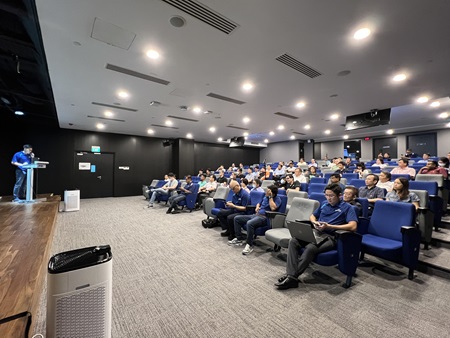
Dialogue session with aerospace and electroplating companies.
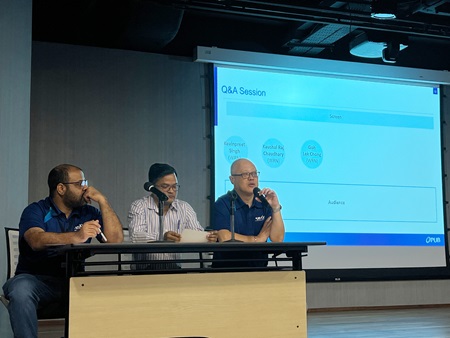
Q&A session with toxic industrial waste collection companies.
To date, we have conducted the following dialogue sessions:
| No. | Industry Engaged | Date of Session |
|---|---|---|
| 1 | Waste Management - Class C General Waste Collectors | October 2023 |
| 2 | Waste Management - Toxic Industrial Waste Collectors | December 2023 |
| 3 | Aerospace and Electroplating | April 2024 |
| 4 | Semiconductor | July 2024 |
| 5 | Food & Beverage | July 2024 |
| 6 | Pharmaceutical | September 2024 |
| 7 | Waste Management - Toxic Industrial Waste Collectors | June 2025 |
| 8 | Waste Management - Class C General Waste Collectors | Dec 2025 |
On 28 November 2024, PUB launched a media feature comprising a presentation showcasing Singapore's strategy and technologies for managing trade effluent discharge to safeguard used water resources for NEWater recycling.
PUB's Trade Effluent Management Strategy
PUB highlighted Singapore's comprehensive approach structured around four key pillars:
1. Prevention and Deterrence
PUB reviews chemicals, discharge quantity, and quality before granting approvals to protect the public sewerage system and NEWater production. Sewers are monitored 24/7 through online sensors including Microbial Electrochemical Sensors (MES) for heavy metals and toxic chemicals, and VOC Remote Monitoring Units for prohibited organic compounds.
2. Enforcement and Penalty
PUB enforces compliance through rigorous approval processes, regular inspections, and enforcement actions. The Sewerage and Drainage Act and Trade Effluent Regulations are regularly reviewed to strengthen deterrence and adapt to industrial changes.
3. Capability Development
PUB leverages technology to enhance monitoring, collaborates with research institutions to develop solutions when commercial options are unavailable, and adopts innovations like the MES system and VOC monitoring units.
4. Stakeholder Engagement
PUB engages factory owners and trade associations through regular dialogue sessions to raise awareness, provide regulatory guidance, and share best practices.
The media feature concluded with a field demonstration at a public sewerage manhole showcasing inspection procedures.
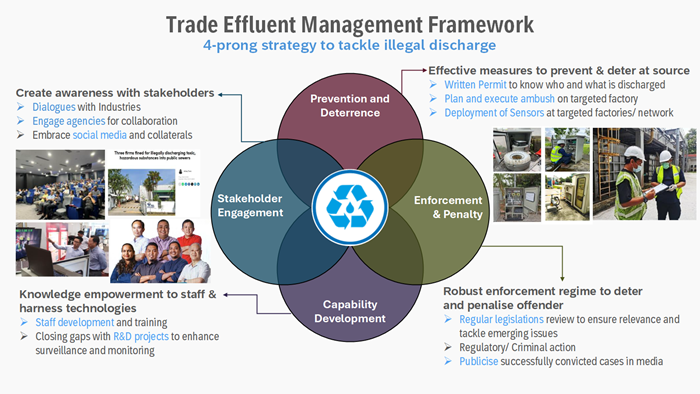
Overview of PUB's four-prong strategy to tackle illegal discharges.
Media Coverage
PUB works closely with media partners to raise awareness, helping the public and businesses understand their responsibilities and what proper wastewater management looks like. On top of that, PUB leverages technology to monitor wastewater discharges. Together, we can play a part in keeping Singapore's water clean and safe. Click on the links below to find out more.
| Date of Release | Media Outlet | Publication Title |
|---|---|---|
| 16 Dec 2024 | Channel News Asia | PUB using real-time water quality sensors to monitor companies' illegal discharge |
| 16 Dec 2024 | The Straits Times Online | Treating industrial wastewater more complex as manufacturing advances: Waste management firm |
| 16 Dec 2024 | 8world |
Article – 非法排放污水 公用事业局每年平均取缔逾40起 Video – 公用事业局在全岛设置了100个污水监测仪 |
| 17 Dec 2024 | The Straits Times | Industrial wastewater now more complex to treat: Waste firm |
Innovation and Technology
PUB harnesses innovative technologies and smart solutions to safeguard Singapore's sewerage infrastructure and ensure the quality of used water for sustainable water management.
SMART Technologies
To protect Singapore's sewerage infrastructure and maintain used water quality, PUB deploys SMART technologies with sensors and AI capabilities in four key areas:
Click here to understand the different sensors and AI capabilities used in the above focus areas.
Advanced Monitoring Systems
The illegal discharge of hazardous substances into the public sewerage system poses serious risks including fire and health hazards for workers, compromised operational integrity of the sewerage network, and disruption to used water reclamation and NEWater production processes.
PUB has deployed two advanced online monitoring systems at targeted trade premises and within the public sewerage network to detect illegal trade effluent discharge:
• Microbial Electrochemical Sensors (MES) – monitor heavy metals, cyanide, and other toxic chemicals
• Volatile Organic Compounds (VOC) Monitoring Units – detect prohibited organic compounds
What are Emerging Contaminants (ECs) and why it matters?
ECs are substances increasingly detected at low levels in surface water that are not yet widely regulated but may pose environmental or human health concerns. Examples include pharmaceuticals, pesticides, industrial chemicals, surfactants, personal care products, and endocrine disrupting compounds.
ECs may affect water treatment processes and the environment. For countries like Singapore, where water recycling is critical to sustainable supply, managing ECs is especially important.
Global Approaches to Managing ECs
Countries are exploring strategies such as legislation to regulate ECs, source control practices to reduce discharge at source, and new detection technologies to monitor ECs effectively.
PUB collaborates with international counterparts to exchange knowledge and develop solutions that support water sustainability and protect public health.
Through these innovative approaches and technologies, PUB demonstrates its commitment to staying at the forefront of water management solutions whilst protecting Singapore's water environment.
PUB conducts regular dialogue sessions with factories across various industries. These sessions are designed to:
• reinforce key requirements for trade effluent discharge compliance
• promote good practices for factories to adopt, and
• provide an interactive platform for factories to share feedback and challenges in meeting legislative requirements
By engaging directly with industry stakeholders, PUB gains valuable insights into ground-level concerns and strengthens rapport with key stakeholders.
During these sessions, PUB typically shares:
• Why trade effluent discharge needs to be regulated
• How PUB safeguards Singapore’s used water resources
• How factories can play their part
• Past cases of non-compliant trade effluent discharge in the invited industry, and how similar issues can be prevented
• Amendments to the legislation, if any
Depending on the industry, PUB may also share planned requirements – such as the installation of monitoring instruments in factories. This ensures businesses are informed in advance and gives PUB the opportunity to understand industry concerns before implementing new measures.
Dialogue session with aerospace and electroplating companies.
Q&A session with toxic industrial waste collection companies.
To date, we have conducted the following dialogue sessions:
| No. | Industry Engaged | Date of Session |
|---|---|---|
| 1 | Waste Management - Class C General Waste Collectors | October 2023 |
| 2 | Waste Management - Toxic Industrial Waste Collectors | December 2023 |
| 3 | Aerospace and Electroplating | April 2024 |
| 4 | Semiconductor | July 2024 |
| 5 | Food & Beverage | July 2024 |
| 6 | Pharmaceutical | September 2024 |
| 7 | Waste Management - Toxic Industrial Waste Collectors | June 2025 |
| 8 | Waste Management - Class C General Waste Collectors | Dec 2025 |
On 28 November 2024, PUB launched a media feature comprising a presentation showcasing Singapore's strategy and technologies for managing trade effluent discharge to safeguard used water resources for NEWater recycling.
PUB's Trade Effluent Management Strategy
PUB highlighted Singapore's comprehensive approach structured around four key pillars:
1. Prevention and Deterrence
PUB reviews chemicals, discharge quantity, and quality before granting approvals to protect the public sewerage system and NEWater production. Sewers are monitored 24/7 through online sensors including Microbial Electrochemical Sensors (MES) for heavy metals and toxic chemicals, and VOC Remote Monitoring Units for prohibited organic compounds.
2. Enforcement and Penalty
PUB enforces compliance through rigorous approval processes, regular inspections, and enforcement actions. The Sewerage and Drainage Act and Trade Effluent Regulations are regularly reviewed to strengthen deterrence and adapt to industrial changes.
3. Capability Development
PUB leverages technology to enhance monitoring, collaborates with research institutions to develop solutions when commercial options are unavailable, and adopts innovations like the MES system and VOC monitoring units.
4. Stakeholder Engagement
PUB engages factory owners and trade associations through regular dialogue sessions to raise awareness, provide regulatory guidance, and share best practices.
The media feature concluded with a field demonstration at a public sewerage manhole showcasing inspection procedures.
Overview of PUB's four-prong strategy to tackle illegal discharges.
Media Coverage
PUB works closely with media partners to raise awareness, helping the public and businesses understand their responsibilities and what proper wastewater management looks like. On top of that, PUB leverages technology to monitor wastewater discharges. Together, we can play a part in keeping Singapore's water clean and safe. Click on the links below to find out more.
| Date of Release | Media Outlet | Publication Title |
|---|---|---|
| 16 Dec 2024 | Channel News Asia | PUB using real-time water quality sensors to monitor companies' illegal discharge |
| 16 Dec 2024 | The Straits Times Online | Treating industrial wastewater more complex as manufacturing advances: Waste management firm |
| 16 Dec 2024 | 8world |
Article – 非法排放污水 公用事业局每年平均取缔逾40起 Video – 公用事业局在全岛设置了100个污水监测仪 |
| 17 Dec 2024 | The Straits Times | Industrial wastewater now more complex to treat: Waste firm |
Innovation and Technology
PUB harnesses innovative technologies and smart solutions to safeguard Singapore's sewerage infrastructure and ensure the quality of used water for sustainable water management.
SMART Technologies
To protect Singapore's sewerage infrastructure and maintain used water quality, PUB deploys SMART technologies with sensors and AI capabilities in four key areas:
Click here to understand the different sensors and AI capabilities used in the above focus areas.
Advanced Monitoring Systems
The illegal discharge of hazardous substances into the public sewerage system poses serious risks including fire and health hazards for workers, compromised operational integrity of the sewerage network, and disruption to used water reclamation and NEWater production processes.
PUB has deployed two advanced online monitoring systems at targeted trade premises and within the public sewerage network to detect illegal trade effluent discharge:
• Microbial Electrochemical Sensors (MES) – monitor heavy metals, cyanide, and other toxic chemicals
• Volatile Organic Compounds (VOC) Monitoring Units – detect prohibited organic compounds
What are Emerging Contaminants (ECs) and why it matters?
ECs are substances increasingly detected at low levels in surface water that are not yet widely regulated but may pose environmental or human health concerns. Examples include pharmaceuticals, pesticides, industrial chemicals, surfactants, personal care products, and endocrine disrupting compounds.
ECs may affect water treatment processes and the environment. For countries like Singapore, where water recycling is critical to sustainable supply, managing ECs is especially important.
Global Approaches to Managing ECs
Countries are exploring strategies such as legislation to regulate ECs, source control practices to reduce discharge at source, and new detection technologies to monitor ECs effectively.
PUB collaborates with international counterparts to exchange knowledge and develop solutions that support water sustainability and protect public health.
Through these innovative approaches and technologies, PUB demonstrates its commitment to staying at the forefront of water management solutions whilst protecting Singapore's water environment.
