Official website links end with .gov.sg
A Singapore Government Agency Website


Secure websites use HTTPS


All trade effluent discharged into Singapore’s public sewerage system must comply with the limits set out in the Sewerage and Drainage (Trade Effluent) Regulations [SD(TE)R].
PUB’s Trade Effluent Fee (TEF) scheme is an opt-in programme for businesses that discharge biodegradable waste but are unable to:
• Install their own wastewater treatment plants, or
• Engage licensed waste collectors to meet the discharge limits under the SD(TE)R.
The TEF scheme allows payees to discharge higher loadings of organic pollutants into the public sewerage system, specifically Biochemical Oxygen Demand (BOD) and Total Suspended Solids (TSS).
Once approved, businesses enrolled in the TEF scheme will pay fees for the discharge of such trade effluent into the public sewerage system. The fees are determined according to the scale set out in the Fifth Schedule of the Requirements for Discharge of Trade Effluent into the Public Sewerage System.
Trade premises that are unable to install a wastewater treatment plant (WWTP) (e.g. due to space constraints), or engage a licensed waste collector to meet discharge limits for BOD or TSS, may apply for the Trade Effluent Fee (TEF) scheme if their effluent contains BOD or TSS concentrations above 400 mg/L.
However, approval will not be granted if trade effluent contains:
• BOD greater than 6,000 mg/L, or
• TSS greater than 6,000 mg/L, or
• Chemical Oxygen Demand (COD) greater than 10,000 mg/L, or more than 3 times the BOD concentration (whichever is lower).
For trade premises eligible for the TEF scheme:
• A TEF account will be opened upon payment of a security deposit.
• Trade premises onboard will undergo an Interim Monitoring Period of 6 to 12 months to determine the representative discharge quality of their effluent.
During this period:
• PUB and/or authorised contractors will collect and test effluent samples.
• A moving average of the results will be used to reflect overall discharge quality, reducing the impact of fluctuations.
• Discharge quantity will be monitored using:
(a) Water consumption records, and
(b) Monthly declarations of domestic water usage and product water content via the Monthly Return Form, which must be submitted to PUB each month.
After the monitoring period, PUB will fix the billing parameters, including:
• BOD and TSS concentrations, and
• The discharge ratio (defined as the ratio of TE over Water Consumption).
The TEF is calculated based on both the quality and volume of trade effluent discharged into the public sewerage system:

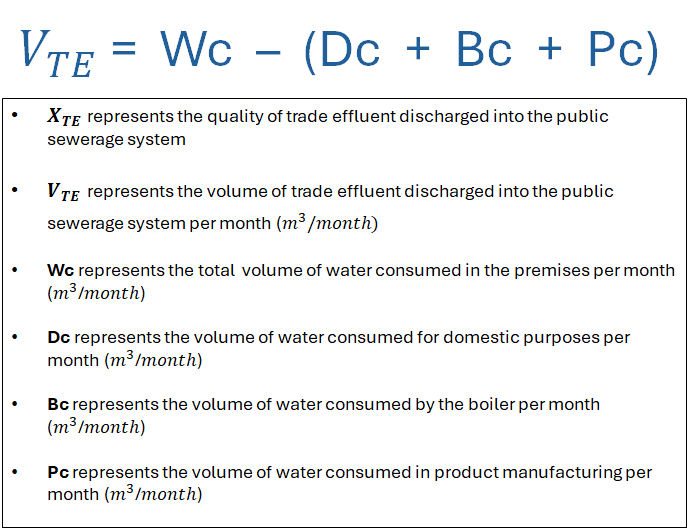
The quality of trade effluent (XTE) is determined through samples collected from the trade premises. Applicable charges are applied according to the rates specified in the Scale of Fees for BOD and TSS.
The volume of trade effluent (VTE) is calculated by deducting water used for domestic purposes, boiler operations, and product manufacturing from the total monthly water consumption. Please see the formula below for the derivation of VTE.
Example of TEF computation
If the BOD concentration of the trade effluent is 500 mg/L, the applicable rate (based on the Scale of Fees for BOD and TSS) is $0.5232 per m³.
For a trade effluent discharge volume of 1,000 m³, the TEF is calculated as:
TEF = 1,000 m³ × $0.5232/m³ = $523.20
So, the total fee payable would be $523.20.
The scale of fees below applies to trade effluent discharge based on BOD and TSS concentrations.
For the most up to date rates, please refer to the Fifth Schedule of the Sewerage and Drainage (Trade Effluent) Regulations.
The table below is extracted from the Fifth Schedule of the link above.
| Concentration of BOD5 or TSS (milligrams per litre of trade effluent) | Fee for BOD5 (cents per cubic metre) | Fee for TSS (cents per cubic metre) |
|---|---|---|
| Exceeding 400 but not exceeding 600 | 52.32 | 52.32 |
| Exceeding 600 but not exceeding 800 | 104.64 | 104.64 |
| Exceeding 800 but not exceeding 1,000 | 156.96 | 156.96 |
| Exceeding 1,000 but not exceeding 1,200 | 209.28 | 209.28 |
| Exceeding 1,200 but not exceeding 1,400 | 261.60 | 261.60 |
| Exceeding 1,400 but not exceeding 1,600 | 313.92 | 313.92 |
| Exceeding 1,600 but not exceeding 1,800 | 366.24 | 366.24 |
| Exceeding 1,800 but not exceeding 2,000 | 418.56 | 418.56 |
| Exceeding 2,000 but not exceeding 2,200 | 470.88 | 470.88 |
| Exceeding 2,200 but not exceeding 2,400 | 523.20 | 523.20 |
| Exceeding 2,400 but not exceeding 2,600 | 575.52 | 575.52 |
| Exceeding 2,600 but not exceeding 2,800 | 627.84 | 627.84 |
| Exceeding 2,800 but not exceeding 3,000 | 680.16 | 680.16 |
| Exceeding 3,000 but not exceeding 3,200 | 732.48 | 732.48 |
| Exceeding 3,200 but not exceeding 3,400 | 784.80 | 784.80 |
| Exceeding 3,400 but not exceeding 3,600 | 837.12 | 837.12 |
| Exceeding 3,600 but not exceeding 3,800 | 889.44 | 889.44 |
| Exceeding 3,800 but not exceeding 4,000 | 941.76 | 941.76 |
| Exceeding 4,000 but not exceeding 4,200 | 994.08 | 994.08 |
| Exceeding 4,200 but not exceeding 4,400 | 1046.40 | 1046.40 |
| Exceeding 4,400 but not exceeding 4,600 | 1098.72 | 1098.72 |
| Exceeding 4,600 but not exceeding 4,800 | 1151.04 | 1151.04 |
| Exceeding 4,800 but not exceeding 5,000 | 1203.36 | 1203.36 |
| Exceeding 5,000 but not exceeding 5,200 | 1255.68 | 1255.68 |
| Exceeding 5,200 but not exceeding 5,400 | 1308 | 1308 |
| Exceeding 5,400 but not exceeding 5,600 | 1360.32 | 1360.32 |
| Exceeding 5,600 but not exceeding 5,800 | 1412.64 | 1412.64 |
| Exceeding 5,800 but not exceeding 6,000 | 1464.96 | 1464.96 |
Note:
BOD5 = Biochemical Oxygen Demand (5 day at 20 Degree Celsius)
TSS = Total Suspended Solids
Trade premises that are unable to install a wastewater treatment plant (WWTP) (e.g. due to space constraints), or engage a licensed waste collector to meet discharge limits for BOD or TSS, may apply for the Trade Effluent Fee (TEF) scheme if their effluent contains BOD or TSS concentrations above 400 mg/L.
However, approval will not be granted if trade effluent contains:
• BOD greater than 6,000 mg/L, or
• TSS greater than 6,000 mg/L, or
• Chemical Oxygen Demand (COD) greater than 10,000 mg/L, or more than 3 times the BOD concentration (whichever is lower).
For trade premises eligible for the TEF scheme:
• A TEF account will be opened upon payment of a security deposit.
• Trade premises onboard will undergo an Interim Monitoring Period of 6 to 12 months to determine the representative discharge quality of their effluent.
During this period:
• PUB and/or authorised contractors will collect and test effluent samples.
• A moving average of the results will be used to reflect overall discharge quality, reducing the impact of fluctuations.
• Discharge quantity will be monitored using:
(a) Water consumption records, and
(b) Monthly declarations of domestic water usage and product water content via the Monthly Return Form, which must be submitted to PUB each month.
After the monitoring period, PUB will fix the billing parameters, including:
• BOD and TSS concentrations, and
• The discharge ratio (defined as the ratio of TE over Water Consumption).
The TEF is calculated based on both the quality and volume of trade effluent discharged into the public sewerage system:
The quality of trade effluent (XTE) is determined through samples collected from the trade premises. Applicable charges are applied according to the rates specified in the Scale of Fees for BOD and TSS.
The volume of trade effluent (VTE) is calculated by deducting water used for domestic purposes, boiler operations, and product manufacturing from the total monthly water consumption. Please see the formula below for the derivation of VTE.
Example of TEF computation
If the BOD concentration of the trade effluent is 500 mg/L, the applicable rate (based on the Scale of Fees for BOD and TSS) is $0.5232 per m³.
For a trade effluent discharge volume of 1,000 m³, the TEF is calculated as:
TEF = 1,000 m³ × $0.5232/m³ = $523.20
So, the total fee payable would be $523.20.
The scale of fees below applies to trade effluent discharge based on BOD and TSS concentrations.
For the most up to date rates, please refer to the Fifth Schedule of the Sewerage and Drainage (Trade Effluent) Regulations.
The table below is extracted from the Fifth Schedule of the link above.
| Concentration of BOD5 or TSS (milligrams per litre of trade effluent) | Fee for BOD5 (cents per cubic metre) | Fee for TSS (cents per cubic metre) |
|---|---|---|
| Exceeding 400 but not exceeding 600 | 52.32 | 52.32 |
| Exceeding 600 but not exceeding 800 | 104.64 | 104.64 |
| Exceeding 800 but not exceeding 1,000 | 156.96 | 156.96 |
| Exceeding 1,000 but not exceeding 1,200 | 209.28 | 209.28 |
| Exceeding 1,200 but not exceeding 1,400 | 261.60 | 261.60 |
| Exceeding 1,400 but not exceeding 1,600 | 313.92 | 313.92 |
| Exceeding 1,600 but not exceeding 1,800 | 366.24 | 366.24 |
| Exceeding 1,800 but not exceeding 2,000 | 418.56 | 418.56 |
| Exceeding 2,000 but not exceeding 2,200 | 470.88 | 470.88 |
| Exceeding 2,200 but not exceeding 2,400 | 523.20 | 523.20 |
| Exceeding 2,400 but not exceeding 2,600 | 575.52 | 575.52 |
| Exceeding 2,600 but not exceeding 2,800 | 627.84 | 627.84 |
| Exceeding 2,800 but not exceeding 3,000 | 680.16 | 680.16 |
| Exceeding 3,000 but not exceeding 3,200 | 732.48 | 732.48 |
| Exceeding 3,200 but not exceeding 3,400 | 784.80 | 784.80 |
| Exceeding 3,400 but not exceeding 3,600 | 837.12 | 837.12 |
| Exceeding 3,600 but not exceeding 3,800 | 889.44 | 889.44 |
| Exceeding 3,800 but not exceeding 4,000 | 941.76 | 941.76 |
| Exceeding 4,000 but not exceeding 4,200 | 994.08 | 994.08 |
| Exceeding 4,200 but not exceeding 4,400 | 1046.40 | 1046.40 |
| Exceeding 4,400 but not exceeding 4,600 | 1098.72 | 1098.72 |
| Exceeding 4,600 but not exceeding 4,800 | 1151.04 | 1151.04 |
| Exceeding 4,800 but not exceeding 5,000 | 1203.36 | 1203.36 |
| Exceeding 5,000 but not exceeding 5,200 | 1255.68 | 1255.68 |
| Exceeding 5,200 but not exceeding 5,400 | 1308 | 1308 |
| Exceeding 5,400 but not exceeding 5,600 | 1360.32 | 1360.32 |
| Exceeding 5,600 but not exceeding 5,800 | 1412.64 | 1412.64 |
| Exceeding 5,800 but not exceeding 6,000 | 1464.96 | 1464.96 |
Note:
BOD5 = Biochemical Oxygen Demand (5 day at 20 Degree Celsius)
TSS = Total Suspended Solids
