
PUB advances coastal protection with $14 million funding to test-bed five Living Lab projects
17 Jun 2026



Singapore, 17 June 2026 – PUB, Singapore’s National Water Agency, will kickstart the test-bedding of coastal protection measures under the Coastal Protection and Flood Management Research Programme (CFRP)’s1 Living Lab pillar, with a total funding of about $14 million awarded to five projects. The measures will be implemented at selected locations along Singapore’s coastline from 2027.
2 The projects reflect close collaboration with industry partners, universities and government agencies to support Singapore’s long-term coastal resilience efforts. By advancing solutions from research and pilot studies into real coastal environments, PUB aims to build on proven concepts with a view to deploying them at scale in the future.
3 Test-bedding locations are chosen based on technical, operational and environmental factors, including the suitability of site conditions. The results from the five Living Lab projects, which will be assessed over three years, will help determine whether they can be used for future coastal protection works. By test-bedding solutions that have been developed through earlier research, PUB seeks to accelerate learning, refine designs and build confidence for potential future deployment, while supporting the growth of local industry capabilities and cross-sector knowledge transfer.
Five Living Lab projects
a) XblocPlus – Interlocking Concrete Armour Blocks
Team members: National University of Singapore (NUS), Delta Marine Consultants Singapore, Woh Hup Engineering and Sentosa Development Corporation
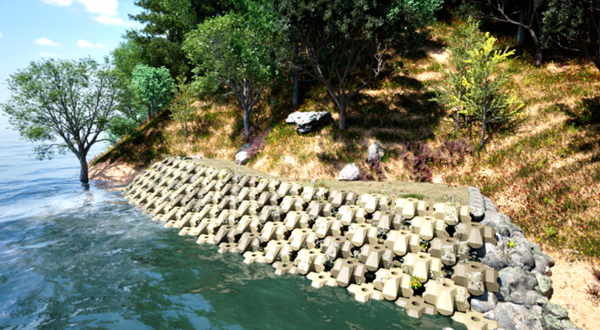
Artist’s impression of XblocPlus at Tanjong Rimau, Sentosa (Credit: Delta Marine Consultants)
4 This project builds on a proof-of-concept completed under PUB’s Global Innovation Challenge in 2021. The project explores the use of modular blocks known as XblocPlus, single-layer interlocking concrete armour units designed to protect shorelines from coastal erosion. The modular system has been successfully applied in more than 40 project locations across 30 countries globally, including in the Asia-Pacific region. Tailored for Singapore’s wave climate, XblocPlus offers a more compact, material-efficient and sustainable alternative to conventional armour rocks. The project will evaluate the long-term hydraulic and structural performance of XblocPlus modules at Tanjong Rimau, at the western end of Sentosa, complementing slope stabilisation works at the site by reducing wave-induced erosion at the slope toe, alongside cost and productivity benefits enabled by more efficient construction and monitoring techniques.
b) Eco-sand Tube with Innovative Eco-material
Team members: Nanyang Technological University (NTU), Surbana Jurong, HSL Constructor and National Parks Board (NParks)
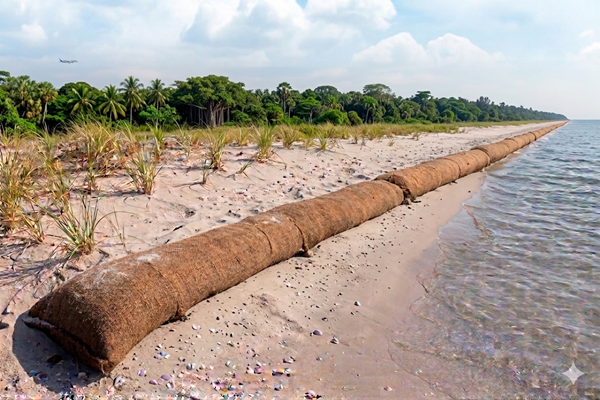
Artist’s impression of eco-sand tube deployed along a coastline (Credit: NTU)
5 The eco-sand tube is one of the 17 ongoing Coastal Protection and Flood Resilience Institute (CFI) Singapore research projects and one of two that has been selected to progress to the test-bedding stage. This innovative measure utilises jute fibre, a biodegradable and natural alternative to synthetic geotextiles, with innovative low carbon eco-material to treat the sand infill. The eco-sand tubes will be used to form a bund-like barrier that will harden over time. These tubes will be deployed at two locations with different coastal conditions: along the Changi coastline and the seaward side of Yishun Dam under sandy and muddy conditions respectively. Building on findings from earlier research, the test-bedding will evaluate the eco-sand tube’s durability, performance and its ability to trap sediments behind it, as well as promoting marine biodiversity.
c) Watertight Modular Solutions
Team members: NUS, KTC Civil Engineering & Construction, Surbana Jurong and Housing & Development Board (HDB)
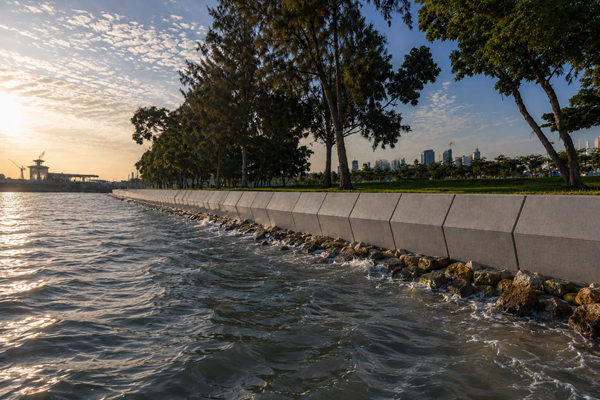
Artist’s impression of Watertight Modular Solution (Credit: NUS)
6 The Watertight Modular Solution is the second CFI Singapore research project identified for the Living Lab pillar, and will be trialled at East Coast Park. It seeks to evaluate the watertightness of modular concrete and geotextile tube units – fabric tubes filled with cement-treated soil as infill material – that can be retrofitted onto existing coastal protection structures such as seawalls and rock revetments. This helps to overcome the challenge of seawater seepage through porous structures, such as rock revetments. Additionally, the modular design also enables coastal protection structures to be raised incrementally over time, supporting Singapore’s long term response to future sea level rise.
d) Shellfish Gabions –Hybrid Solution for Coastal and Ecological Defence
Team members: Singapore University of Technology and Design (SUTD) and Mlion Corporation
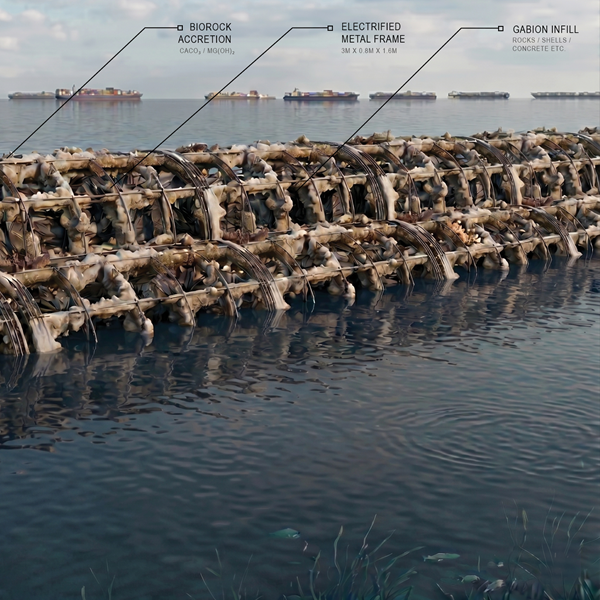
Artist’s impression of Shellfish Gabions at low tide (Credit: SUTD)
7 The project will be test-bedded at East Coast Park and builds on prior research exploring the use of recycled oyster shells at Changi Sailing Club by Dutch engineering consultancy firm Witteveen+Bos. The project taps on Mlion’s expertise in biorock technology, which promotes coral reef growth, to measure and validate the effectiveness of the gabions in dissipating wave energy. Mlion is a local small and medium enterprise (SME) with a regional footprint in providing engineering solutions, including sustainable infrastructure and materials innovation across Southeast Asia.
e) Adaptive Eco-friendly Seawall
Team members: Kajima Corporation, Samwoh Innovation Centre, Delta Marine Consultants Singapore, Oung Construction (S), Singapore Institute of Technology (SIT) and NUS
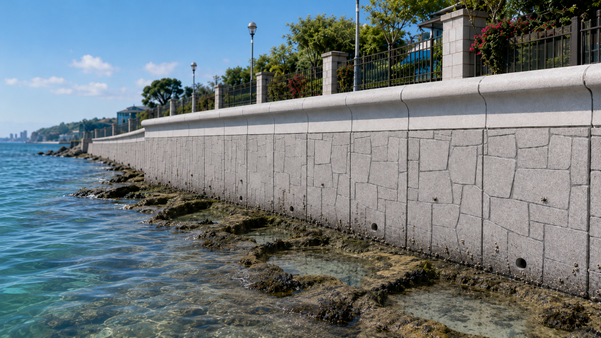
Artist’s impression of Adaptive Eco-friendly Seawall (Credit: Kajima Corporation)
8 The adaptive seawall builds on Japanese construction company Kajima’s project in Tokyo, which integrates eco-friendly features such as grooves and tide pools to enhance marine biodiversity. This project will use precast concrete elements to simulate how coastal protection infrastructure can be built up progressively to respond to gradual sea level rise. In addition, the seawall panels will be constructed using low-carbon materials and equipped with smart sensors and self-healing mechanisms to reduce carbon emission and maintenance costs. The eco-friendly seawall will be test-bedded at Changi Beach to assess its performance while monitoring biodiversity outcomes under local coastal conditions.
- END -
Footnote:
[1] Launched in 2023, the CFRP comprises three pillars – (i) Coastal Protection and Flood Resilience Institute (CFI) Singapore, (ii) Applied Research and (iii) Living Lab – to drive the development and application of solutions, as well as grow a vibrant research and development ecosystem for flood resilience locally. Click here for more details on CFRP.